How the AV1 Video Codec Transforms Business Communication
Contents
After the pandemic, everything jumped from on-site to online, so video has become the center of business communication now, from virtual meetings to security surveillance. But as video quality gets better, so does the need for increased bandwidth and data storage. This is where the AV1 video codec jumps in and answers the question “AV1 Video Codec Mean for Business”; it is a breakthrough mapped out to deliver high-quality video at lower data usage.
Developed by the Alliance for Open Media, AV1 is already making its mark in Microsoft Teams, Zoom, YouTube, and other platforms. It’s not just a new format but a step forward to more efficient and cost-effective video communication.
Looking to modernize your meeting rooms with advanced video technology?
👉 Explore Yealink MeetingBar Systems on Spogmey — optimized for smooth AV1 video conferencing and Microsoft Teams Rooms.
Want to know what makes AV1 a game-changer for your business? Let’s explore.
What Does “Codec” Mean?
Before getting into the real information and cracking the code of “AV1 Video Codec Mean for Business”, let’s first discuss a very common question: ” What does codec mean?
A codec is basically a combination of the two words that are Coder and Decoder. It’s the technology that compresses video files so they’re smaller to send and store, then decodes them so you can view them in full quality. Think of it as how images come in different formats like JPG or PNG, the same is the codec’s way for moving images.
Different video codecs exist: H.264, H.265 (HEVC), and now AV1, each one of them offers better compression and efficiency that lasts for a good long time. Understanding what AV1 encoding is helps businesses grasp why it matters for bandwidth, clarity, and more of the collaboration.
What Is the AV1 Video Codec?
So, what is AV1, and what is the AV1 format exactly? Let’s discuss it so that you get a better understanding of everything.
AV1 (AOMedia Video 1) is an open-source, royalty-free video codec developed in 2018 by the Alliance for Open Media (including Google, Microsoft, Amazon, and Netflix). It’s designed to deliver 30-50% better data compression than older codecs like H.264 and H.265, without giving up on image quality.
This makes AV1 perfect for 4K and even 8k streaming, whether it’s about a virtual meeting, online event, or surveillance footage. Because it’s royalty-free, manufacturers and software providers can use it without paying a license fee, keeping devices more affordable for consumers.
Codec | Release Year | Compression Efficiency | Royalty-Free | Supported Platforms |
H.264 (AVC) | 2003 | Standard | ❌ | Almost all |
H.265 (HEVC) | 2013 | 25–50% Better | ❌ | Moderate |
AV1 | 2018 | 50% Better | ✅ | Teams, Zoom, YouTube |
🔗 External Source: Google Developers Blog – AV1 Codec Overview
Why the AV1 Video Codec Matters for Businesses
The AV1 video codec isn’t just about better video; it’s about business-class efficiency.
Here’s what it means for your company:
Reduced Bandwidth Usage:
AV1 utilizes notably less data while maintaining high visual quality; it’s a perfect fit for remote teams that are working with limited internet speed.
Better Performance in Hybrid Work:
Employees can enjoy stress-free, smoother meetings with fewer lags or pixelation.
Cost Efficiency:
Lower data usage means savings on cloud storage and streaming costs.
Future-Proofing:
As more platforms adopt AV1, your business will already be ready.
In other words, the AV1 Video Codec means for Business is clear; it leads to lower costs, smoother performance, and higher quality, uninterrupted communication.
💡 Expert Insight:
According to Microsoft’s engineering team, integrating AV1 reduced Teams screen-sharing data usage by up to 35%, improving overall stability for remote users.
AV1 for Video Conferencing
Now, when it comes to video conferencing, AV1 is changing the game.
Traditional codecs like H.264 often struggle in weak network conditions. With AV1 for video conferencing, even limited bandwidth can handle crystal clear 1080p or 4K video calls.
Key Advantages:
- Improved Clarity on Low Internet: AV1 dynamically adjusts to weaker connections.
- Better Color & Detail: Great for presenting designs, product demos, or visual reports.
- Wider Support: AV1 in Microsoft Teams, Zoom, and Webex means it’s becoming the new conferencing standard.
For example, Yealink MeetingBars uses AI-powered framing and supports AV1-ready platforms, providing lifelike meetings even in hybrid environments.
AV1 for Video Surveillance
Other than conferencing, AV1 for video surveillance offers major benefits for a security system.
Businesses depend upon IP cameras for safety and monitoring, but storing HD or 4k footage consumes huge bandwidth. AV1 encoding solves this problem.
Benefits of AV1 in Surveillance:
Here are some of its best points:
- Higher Quality, Lower Storage: Save up to 40% storage space without losing image clarity.
- Faster Cloud Uploads: Ideal for companies using remote monitoring solutions.
- Cost Reduction: Less data means lower subscription and backup costs.
For example, Axis Communications has begun integrating AV1 in its new ARTPEC-9 chipset, which powers cameras capable of encoding 4K video with reduced storage requirements.
That means better visibility and cost control for modern security infrastructures.
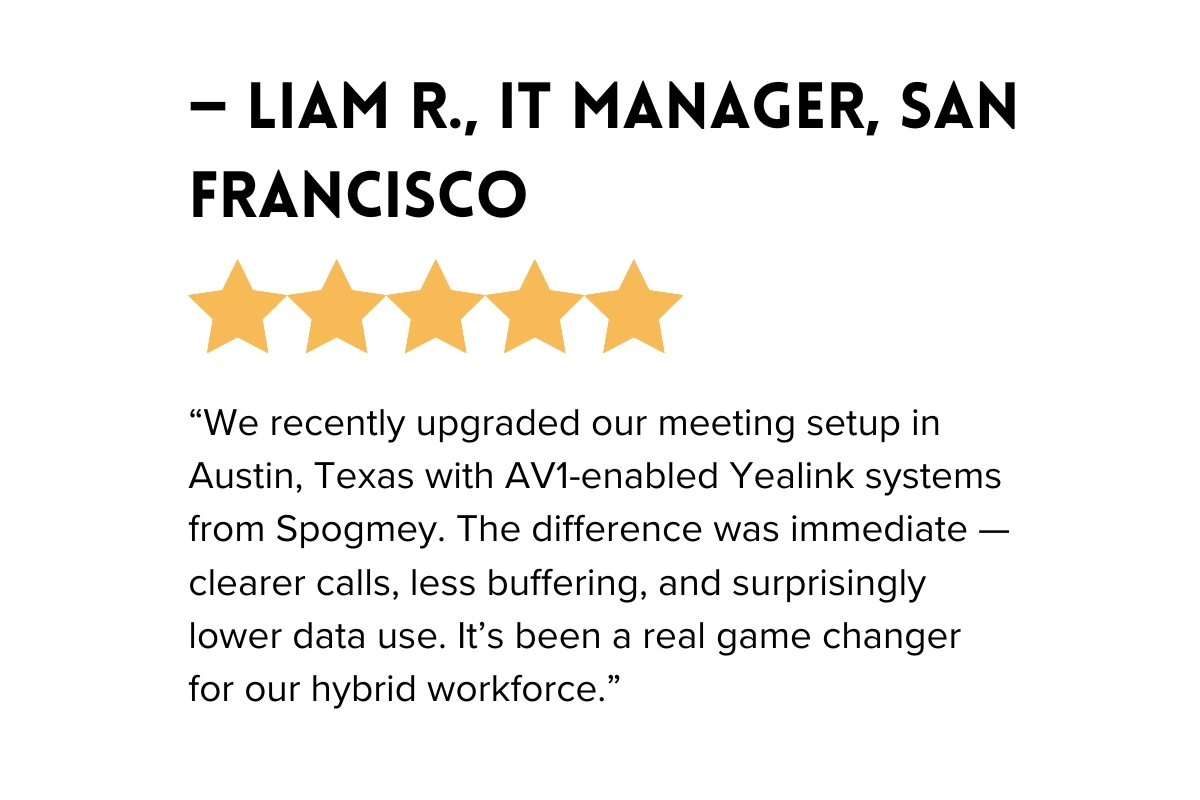
Customer Review (USA-Based)
Limitations of AV1
Everything that excels in a few features also has limitations in other dimensions; we explained the “AV1 Video Codec Mean for Business” part, now we will discuss the limitations, because just like everything, lack a few features, the same goes for AV1 as well. Every technology has limitations.
While AV1 gives stunning efficiency, businesses should be aware of these considerations:
- Limited Hardware Support: Some older devices can’t play videos encoded in AV1 format, which isn’t supported by their hardware.
- Slower Encoding: AV1 encoding can take slightly longer than H.265 due to its complex algorithms.
- Partial Adoption: Not every platform fully supports AV1 yet — though adoption is still,
As more brands like Microsoft, Google, and Yealink implement AV1, these challenges are quickly fading because of competition.
💬 Expert Note: Think of AV1’s transition like USB-C — early limitations, but rapid global adoption due to clear advantages.
The Future of AV1 and Business Readiness
AV1 acts as the future of efficient video communication. With rising trends in hybrid work environments, cloud conferencing, and AI-powered surveillance, adopting AV1-prepared systems guarantees your business stays ahead of the curve.
Upcoming codecs like H.266 (Versatile Video Coding) promise even higher efficiency, but for now, AV1 remains the most practical, cost-effective, and royalty-free option available for real-world use.
Put your money into AV1-compatible hardware today, like Yealink MeetingBar Systems or Axis IP cameras, which means your business is prepared for the next decades of stress-free communications.
Conclusion
The AV1 Video Codec is redefining possibilities for business video.
It’s faster, lighter, and smarter, and is helping companies to save data, cut costs, and deliver clearer, uninterrupted communication. Whether it’s in the meeting room or on security screens.
With proven support from industry heads like Microsoft, Google, and Axis, the AV1 video codec is no longer a question mark; it’s the standard your business should be adopting now.
Got questions about AV1-supported devices or need help choosing the right video conferencing setup for your business?
👉 Reach out to us today — our experts at Spogmey are here to guide you toward the best solution for your team.
FAQs (Frequently Asked Questions)
Yes. AV1 video codec offers up to 30–50% better compression than H.264 (AVC) and H.265 (HEVC). This means businesses can stream or record 4K video conferencing and surveillance feeds using less bandwidth and storage. Plus, AV1 is royalty-free, reducing long-term costs for IT and communications teams.
Absolutely. AV1 in Microsoft Teams improves video quality, especially on low-bandwidth connections. Teams automatically switches to AV1 encoding for users with compatible devices, providing clearer visuals and smoother motion during video meetings without increasing data usage.
AV1 for video surveillance delivers high-resolution footage while cutting down on network load and storage needs. This makes it ideal for businesses using IP cameras or NVR systems that store 24/7 video. It also integrates well with advanced cloud-based monitoring platforms, allowing longer video retention at a lower cost.
Not yet. While AV1 codecs are supported by most modern browsers (Chrome, Edge, Firefox) and devices from brands like Intel, NVIDIA, and Apple, some older systems can’t play videos encoded in AV1 format. Businesses planning upgrades should ensure new endpoints support AV1 decoding for best results.
You can start by using platforms that already support AV1 encoding, such as Zoom, Google Meet, and Microsoft Teams. For video storage or marketing, YouTube and Netflix also encode streams in AV1, showing its wide adoption. Businesses can test compatibility using free AV1 sample videos or open-source players like VLC.
The biggest limitation is hardware support. AV1 encoding requires powerful processors or GPUs, especially for real-time streaming or 8K content. However, as new chipsets and IP cameras (like Yealink and Axis) start adopting AV1 natively, this limitation is rapidly fading.
If your business depends on video conferencing or surveillance, it’s smart to start planning now. Many Yealink video solutions and Microsoft Teams-certified devices already support AV1, offering smoother performance. Early adoption means better future-proofing, lower operational costs, and improved collaboration quality.
You can explore AV1-ready devices like Yealink MeetingBars and IP video phones directly from Spogmey’s official store — your trusted authorized reseller for Yealink and other enterprise video solutions in the USA.
✍️ Author’s Bio
This article is written by Spogmey’s Research & Content Team, who collaborate with IT managers and hybrid teams across the USA to assess and review collaboration tools from brands like Yealink, Grandstream, OWL Labs, Snom, TP Link, and Ubiquiti Networks. With hands-on testing in real small-to-medium-sized business environments, our specialists deliver practical understandings that help decision-makers pick the right technology for their meeting rooms and business needs.
What is a SIP Phone? The Complete Beginner-Friendly Guide
Why Hang Up with Calling Party Control Matters in 2025
Difference Between a Video Conferencing Camera and a Webcam
Why Choose Spogmey?
Independent
We’re a fully independent wholesaler so you can count on us for unbiased advice.
Tech Support
Contact us before a sale, after a sale, whenever. Certified experts will help you.
Fast Delivery
Enjoy fast delivery with reliable service ensuring speed and satisfaction.
Blind Drop Shipping
Simplify your business — let us take care of storage and shipping.
Vendor Partners
No gray market here — we’re authorized to sell and support our products.
Provisioning
We configure endpoints to integrate with your VoIP system — no work for you.
Secure Shopping
256-bit SSL encryption protocols protect you and your information.
Payment Options
Flexible — use the payment method that works for you.
INFORMATION
PROGRAMS
CONTACT
Address
5900 Balcones Dr #19504 Austin TX 78731
- © 2025 Spogmey
- Terms & Conditions
- Sitemap
- Image
- SKU
- Rating
- Price
- Stock
- Availability
- Add to cart
- Description
- Content
- Weight
- Dimensions
- Additional information